In 1707, under a Treaty of Union, the separate Kingdoms of Scotland and England came together to form the new Kingdom of Great Britain. The earlier parliaments of Scotland and England were dissolved and replaced by a new UK parliament based at Westminster in London.

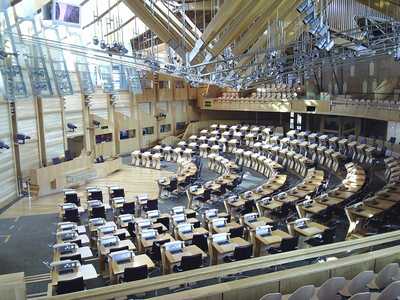
Following a referendum in 1997, the people of Scotland voted in favour of the creation of a new Scottish Parliament. While Westminster continues to remain the supreme UK parliament, it has devolved to the Scottish Parliament various powers that are exercised through its 129 MSPs (Members of the Scottish Parliament). Matters that are not devolved to the Scottish Parliament and which continue to be dealt with by Westminster are called "reserved" matters. The first meeting of the Scottish Parliament took place on 12 May 1999.

The fourth elections to the Scottish Parliament took place on 5 May 2011. The result was a victory for the Scottish Nationalist Party (SNP) who won 68 of the 129 seats in the Parliament. 65 seats are needed for an overall majority. The Scottish Labour Party took 37 seats, the Conservatives 15, the Liberal Democrats 5, the Green Party 2 plus 1 Independent and 1 Member with no party affiliation.

The Scottish Parliament Building - Love it or loath it, you can't ignore it.

Access to the Scottish Parliament is free. There is airport style security at the entrance, but once inside visitors can experience at first hand the architictural splendours of the building.
Entrance:
Entrance to the Scottish Parliament building is free of charge. Visitors can explore the public areas of the building without taking a tour.
Guided tours
Guided tours are free of charge and normally operate on non-business days when parliament is in session, and daily when parliament is in recess. Booking in advance for tours is advised and can be done through Visitor Services at the Scottish Parliament or by completing an online booking form on the Parliaments website at http://www.scottish.parliament.uk/visitandlearn/32091.aspx

There is also an exhibition about the parliament as well as a creche (booking advisable), a shop and a cafe.

The Scottish Parliament is normally open 6 days a week as follows:-
Weekdays:
Business days (normally Tuesday - Thursday)
09.00 - 18.30
Non-business days (normally Mondays and Fridays and all weekdays when parliament is in recess)
10.00 - 17.00
Saturdays and Public holidays:
10.00 - 17.00 (All year)
Sundays: Closed
Last admission 30 minutes before closing.

Business Days
On Parliamentary business days, visitors can watch a committee or a meeting of the Parliament in the debating chamber. Booking in advance is advised, and is essential for First Minister's Question Time on Thursdays. Tickets can be booked by contacting Visitor Services at the Scottish Parliament or by completing an online booking form on the Parliaments website at
http://www.scottish.parliament.uk/visitandlearn/436.aspx
(with the exception of tickets for First Ministers Questions - these can be booked by telephone only by contacting Visitor Services on 0131 348 5200)

Along the Canongate side of the building there are many inscribed stone plates with Scottish sayings and poems like the one shown below.

One of the best things about the Scottish Parliament building is that, like Edinburgh itself, there is always something new and unusual to discover around virtually every corner. And the more often one visits the building, which has become a major Edinburgh attraction in its own right, the more there seems to be to appreciate and enjoy.

The initial estimate for the Scottish Parliament was put at between £10 and £40 million. However, the final cost was a staggering £414 million, more than ten times over budget. The award winning Catalan Architect, Enric Miralles, also died tragically in 2000 of a brain tumour, aged just 45, during the course of the Parliament's construction. Meanwhile, the intended 2001 opening date also slipped back to 2004.

As might be imagined, the runaway cost of the parliament generated huge public controversy within Scotland. In an attempt to get to the root of what had gone wrong, a major public inquiry was held under the chairmanship of Lord Fraser of Carmyllie.
In his report Lord Fraser said that while he had a number of sharp criticisms and recommendations to make on matters that ought to have been much better understood, he concluded that there was no single villain of the piece. He highlighted however that some catastrophically expensive decisions had been taken, principal among which was the decision - not cleared with Ministers - to follow the procurement route of construction management.